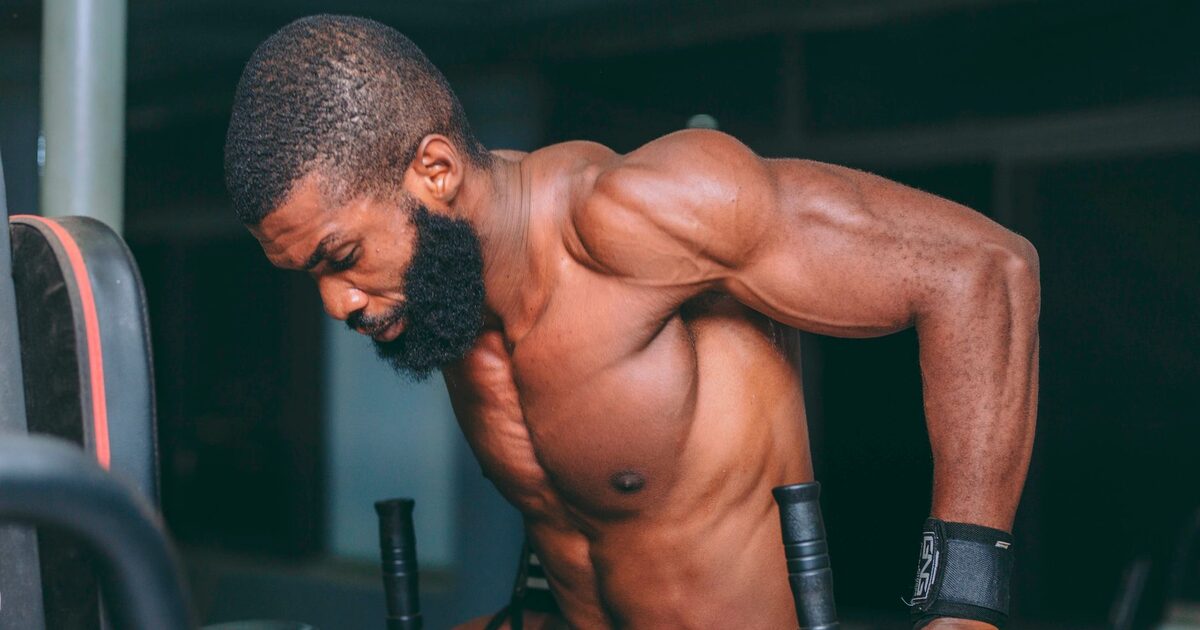
The parallel bar dip is two exercises hiding in one movement. Lean your torso forward and it hammers the chest like a steep decline press. Stay bolt upright and it becomes one of the hardest triceps builders you can load. Same bars, same dip station — what changes is your trunk angle, elbow path, and where you stop. Get those three right and you can dial the emphasis toward whichever muscle you want on a given day.
One movement, two jobs
A dip is a vertical pressing pattern: your hands stay fixed and your body travels down and up between them. Because your torso can pivot freely at the shoulder, a small change in lean redistributes the work between the pectorals and the triceps.
Lean forward roughly 30 degrees and your shoulders move into more flexion and horizontal adduction — the chest's job. Keep your spine close to vertical and the movement becomes mostly elbow extension, which is the triceps' job. Neither version is "correct"; they're two tools. Powerlifters often chase the triceps version to drive lockout strength, while physique lifters lean in to build the lower-outer chest that a flat bench can miss.
This is the same logic that governs a lot of pressing — the angle of the working limb decides which muscle leads, exactly like grip and path decide the target on a biceps curl. Change the lever, change the muscle.
The three dials that shift the emphasis
Before the two setups, here are the variables you're actually adjusting. Touch any one and the loading shifts.
- Torso lean: the master switch. ~30 degrees forward for chest, near-vertical for triceps.
- Elbow path: flared out to ~45 degrees away from the ribs for chest; tucked closer to the body, tracking back rather than out, for triceps.
- Depth and lockout: chest dips reward a deeper stretch at the bottom; triceps dips reward a hard, full lockout at the top.
Bar width matters too. Wider bars (shoulder-width plus a few inches) encourage the flare and stretch that suit the chest. Narrow, near shoulder-width bars keep the elbows in and favour the triceps. If your gym has angled bars, grip the wider end for chest, the narrower end for triceps.
Chest-focused dips: lean, flare, stretch
The goal here is to put the pecs on stretch under load and press out of it.
- Set up leaning. Once you press to the top, bend at the hips and let your chest fall forward so your shoulders sit ahead of your hands. Bring your feet up behind you and cross your ankles — that posture locks the forward lean in place.
- Let the elbows travel out. As you descend, allow them to drift to roughly 45 degrees from your torso. Think of squeezing something between your forearms at the bottom.
- Go deep — within reason. Lower until your shoulders drop just below your elbows, or until you feel a strong stretch across the chest without sharp pain at the front of the shoulder. For most people that's about a 90-to-100-degree elbow bend.
- Press and stop short. Drive back up but don't fully lock out — stopping a few degrees shy keeps tension on the chest and reduces the triceps' share of the lockout.
Cue that works: "Make a wide arc with your chest." Tempo helps too — a 3-second descent into the stretch builds far more pec tension than dropping like a stone. Three sets of 8–12 with this style is a solid chest-day staple.
Triceps-focused dips: tall, tucked, locked
Now you want the chest to contribute as little as possible so the triceps drive the rep.
- Stay vertical. Keep your torso stacked over your hands, ribs down, a slight bend at the hips so your legs hang straight or just in front. The less you lean, the more the elbows do.
- Tuck the elbows. Keep them pointing back, brushing close to your sides. They should not flare out to the sides; flaring shifts the work to the chest.
- Use a shorter range. Lower until your elbows hit about 90 degrees and no further. Going deep with an upright torso loads the front of the shoulder without adding much for the triceps.
- Lock out hard. Finish every rep with a full, deliberate elbow extension and a brief squeeze. The top portion is where the triceps work hardest, so don't cut it.
Because the triceps are a smaller engine, you'll usually handle less weight here and the reps get tough faster. Sets of 6–10 fit this version well. If you want to bias the long head, the upright dip already does a decent job, but pairing it with overhead extensions covers the rest of the muscle.
Chest vs triceps dips at a glance
| Variable | Chest focus | Triceps focus |
|---|---|---|
| Torso | Leaned ~30° forward | Near vertical |
| Elbows | Flared ~45° | Tucked, tracking back |
| Bottom | Deep stretch, shoulders below elbows | Stop near 90° |
| Top | Stop just short of lockout | Full, hard lockout |
| Bar width | Wider | Narrower (~shoulder-width) |
| Typical reps | 8–12 | 6–10 |
Building the strength to dip
If a clean bodyweight rep isn't there yet, don't grind ugly reps. Build to it in this order:
- Bench dips with feet down for a few weeks to teach the lockout, then progress to feet raised on a second bench.
- Band-assisted dips on the bars — loop a band across and kneel in it. Drop to a lighter band as you get stronger.
- Slow negatives: jump to the top and lower under control for 4–5 seconds. Three to five of these build the bottom position fast.
Once 12–15 clean bodyweight reps feel easy, add load with a dip belt rather than chasing endless reps. For chest and triceps mass, the 6–12 range under added weight does more than sets of 25.
Shoulder safety and common faults
Dips get blamed for shoulder pain, but the issue is almost always depth plus an unstable bottom, not the exercise itself. Keep these in mind:
- Don't sink into a passive bottom. Dropping until your shoulders shrug up toward your ears stresses the front of the joint. Stay active and own the bottom position.
- Set your scapulae. Think "proud chest, shoulders down and back" before you descend, the same bracing discipline that protects your spine on a deadlift.
- Match depth to your mobility. If your shoulders complain past a certain point, stop there. A pain-free 90-degree dip beats a deep one that flares the joint.
- No bouncing or kipping. If you're swinging your legs to generate momentum, the set is over.
If dips simply don't agree with your shoulders, a slight forward lean usually feels friendlier than dead-vertical, and a machine-assisted dip or a close-grip press will train the same muscles without the deep stretch. Pick your dial — lean for chest, stay tall for triceps — and the dip earns its place in either workout.
Key takeaways
- Torso lean is the master switch: ~30° forward loads the chest, near-vertical loads the triceps
- Chest dips flare the elbows to ~45° and chase a deep stretch; triceps dips tuck the elbows and lock out hard
- Stop chest dips just short of lockout to keep pec tension; finish triceps dips with a full elbow extension
- Most shoulder pain comes from sinking into a passive bottom, not from dips themselves — own the bottom position
- Build to clean reps with band assistance and slow negatives, then add load with a dip belt in the 6–12 range
Frequently asked questions
Are dips better for chest or triceps?
Neither by default — it depends on how you set up. A forward lean with flared elbows biases the chest, while an upright torso with tucked elbows biases the triceps. You can train both versions in the same week for different goals.
Why do dips hurt my shoulders?
Most often it's going too deep and letting the shoulders shrug up into a passive bottom, which stresses the front of the joint. Set your scapulae down and back, stay active at the bottom, and limit depth to your mobility. A slight forward lean is usually gentler than a dead-vertical position.
Can I build chest and triceps with dips if I can't do one yet?
Yes. Start with bench dips, then band-assisted dips on the bars, and add slow 4-to-5-second negatives. Once you can do 12–15 clean bodyweight reps, add weight with a dip belt and work in the 6–12 rep range.