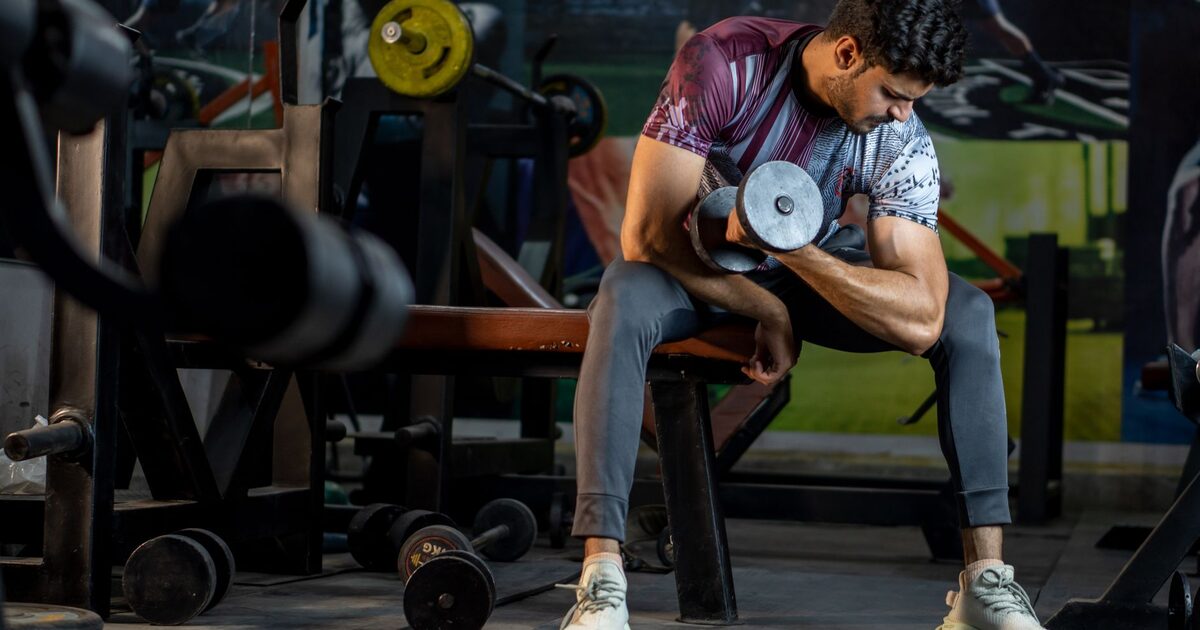
The biceps have a simple job: bend the elbow and turn the palm up. That simplicity is exactly why the curl is so easy to butcher. The curl invites cheating, and the worst part is that the cheating feels productive. You move more weight, you get a pump, and you wonder why your arms haven't grown in a year. Here are the five mistakes that quietly cap your biceps, and the fixes that get them growing again.
Mistake 1: Swinging the weight up with your hips
This is the big one. Watch most people curl and you'll see a tiny hip thrust and a backward lean at the start of every rep. That little hip drive launches the dumbbell past the hardest part of the movement, so the biceps never actually have to work through the bottom third where they're most stretched and most stimulated.
The tell is simple: if your torso moves, the weight is winning. A strict curl keeps your shoulders stacked over your hips and your ribs down. Plant your feet, squeeze your glutes, and brace your abs as if you're about to be poked. If you can't lift the dumbbell without a body english heave, it's too heavy. Drop 10 to 20 percent and the biceps usually light up in a way the heavier weight never delivered. The blunt fix is to curl with your back flat against a wall, heels a few inches out: the wall removes the swing entirely, and whatever you can clean-rep against it is roughly your honest curling weight.
Mistake 2: Letting your elbows drift forward
The biceps flex the elbow, but they also assist in raising the upper arm at the shoulder. So when a rep gets hard near the top, the body recruits the front delt by sliding the elbow forward and up. The dumbbell travels higher, the rep "completes," and tension drains out of the biceps right at the peak.
Your upper arm should stay roughly vertical and pinned to your side for a standard curl. Picture your elbow as a fixed hinge bolted to your ribs. The forearm moves; the upper arm does not. If you watch from the side and your elbow ends the rep ahead of your shoulder, you've handed the work to your front delt. To groove this, use a seated incline dumbbell curl: the bench drags your arms slightly behind your torso, which makes elbow drift physically impossible and hammers the long head of the biceps at the same time.
Mistake 3: Skipping the bottom half of the rep
Half reps are the most common form of self-deception in the curl. People lower the weight to about 90 degrees, then curl back up, bouncing inside the easy middle range and never straightening the arm. It feels great because the biceps stay under constant, comfortable tension. It builds very little because the most growth-sensitive position is the deep stretch at the bottom, which they're skipping.
Research on training at long muscle lengths keeps pointing the same way: reps that load the stretched position tend to drive more growth than reps stuck in the shortened, easy range. For the biceps that means straightening the elbow almost fully each rep (to a comfortable near-lockout, not a joint-jarring snap) and feeling the stretch before you curl back up. If you fix one thing on this list, control the lowering: take 2 to 3 seconds down on every rep. That slow eccentric is where much of the growth stimulus lives, and dropping the weight in half a second throws most of the set away.
Mistake 4: Ignoring the wrist and the palm
The biceps does two things: it bends the elbow and it supinates, meaning it rotates the forearm so the palm faces up. Most people only train the first half. They curl with a fixed wrist and never use that twist, leaving free growth on the table.
With dumbbells, start each rep with a neutral or slightly pronated grip (thumb up or knuckles slightly inward) and deliberately rotate to a fully supinated, pinky-high position as you curl. Squeezing your pinky up at the top maximally shortens the biceps and gives a far stronger contraction than a flat palm. One caution: don't let the wrist flop backward under load, which bleeds force into the forearm and aggravates the elbow. Keep it neutral and stacked, knuckles pointing roughly at the ceiling at the top.
Mistake 5: Living in the wrong rep range with junk weight
The biceps respond to the same rules as everything else: enough hard sets, taken close enough to failure, with progressive overload over time. Two errors show up here. The first is going too heavy and cheating (covered above). The second is the opposite, doing endless light sets of 25 to 30 with so little tension that nothing is challenged.
For most lifters, curls do their best work in the 8 to 15 rep range, taken to within 1 to 3 reps of failure. Because the biceps are small and recover fast, they tolerate and often need more frequency than people give them: 12 to 20 hard sets per week across two or three sessions is a sensible target. And they have to get harder over time: add a rep, add a small jump in load, or slow the negative. Spinning the same 10kg dumbbells for a year is why arms stall. That same add-load-over-time principle is what makes a heavy hinge like the deadlift keep building, just with bigger jumps.
Quick diagnosis: feel the fault, fix it fast
| What you feel or see | Likely cause | Fix |
|---|---|---|
| Lower back or hips moving on each rep | Swinging the weight up with body english | Curl against a wall; drop 10-20% load |
| Front of the shoulder doing the work | Elbows drifting forward at the top | Pin upper arms to your sides; use an incline bench |
| Big pump but no long-term growth | Half reps in the easy middle range | Straighten the arm; lower for 2-3 seconds |
| Elbow or forearm ache | Wrist bending back under load | Keep the wrist neutral and stacked |
| Weak contraction at the top | No supination, flat palm | Rotate pinky up as you curl |
| Curls feel easy, arms not changing | Too light, never near failure | Train 8-15 reps, 1-3 reps from failure |
How to put a clean curl together
You don't need ten variations, just two or three done honestly. A reliable arm session looks like this:
- Incline dumbbell curl for the stretched long head: 3 sets of 8 to 12, slow negatives, full supination.
- A standing curl variation (EZ-bar or dumbbell) for loaded mid-range work: 3 sets of 10 to 15, strict, no swing.
- A short-head finisher like a preacher or spider curl: 2 to 3 sets of 12 to 15, squeezing hard at the top.
A single pair of adjustable dumbbells covers every variation above, which makes curls ideal at home; the exercise library shows the setup for incline, preacher, and hammer versions with the same kit. Hammer curls (neutral grip, thumbs up) earn a place too: they load the brachialis and brachioradialis, the muscles beneath and beside the biceps that add real width. A few sets of hammers each week is one of the simplest ways to make arms look bigger from every angle.
The part most people forget
Form fixes the stimulus, but the arm is built outside the gym. Biceps are tiny, so whether they grow often comes down to your training and eating, and you won't out-curl a calorie deficit and a low-protein diet. Aim for roughly 1.6 to 2.2 grams of protein per kilogram of bodyweight per day, and eat at or slightly above maintenance if growth is the goal. Our recipes include high-protein options that make hitting that number less of a chore.
The biceps also get a lot of indirect work from heavy lifting. Every chin-up, row, and pulldown loads them hard, and a solid bench press builds the triceps and shoulders that fill out an arm. Train the big lifts well and your arms get a head start, which makes strict curls the finishing touch rather than the whole show.
Strip out the swing, lock the elbows, lower under control, use the full range, and turn the palm up. None of it is complicated; it's just harder and less flattering than the cheating version, which is exactly why it works.
Key takeaways
- If your torso swings or your hips thrust on a curl, the weight is too heavy; drop 10-20% and keep your upper arms pinned to your sides.
- Keep your elbow a fixed hinge bolted to your ribs; letting it drift forward hands the work to your front delt.
- Straighten the arm and lower for 2-3 seconds every rep; the deep stretch and slow negative drive most of the growth.
- Rotate your pinky up to full supination at the top for a far stronger biceps contraction, and keep the wrist neutral.
- Train curls in the 8-15 rep range, 1-3 reps from failure, with 12-20 hard sets per week and progressive overload over time.
Frequently asked questions
How heavy should I go on bicep curls?
Light enough that you can lift it without swinging your hips or torso. For most lifters that means a weight you can control for 8 to 15 strict reps, stopping 1 to 3 reps short of failure. If your back arches or your elbows drift forward to finish the rep, drop the load 10 to 20 percent.
Why aren't my biceps growing even though I curl every week?
Usually it's some mix of cheating with momentum, doing half reps in the easy middle range, and never adding load over time. Biceps grow from full-range reps taken close to failure with progressive overload, plus enough protein and calories to support it. Fix the form first, then make sure the weight or reps climb week to week.
Are dumbbell or barbell curls better for building biceps?
Both work; they just train slightly different things. Dumbbells let you fully supinate (turn the palm up), which gives a stronger contraction and lets you fix side-to-side imbalances. An EZ-bar lets you load more total weight in the mid-range with less wrist strain. The best plan uses both rather than picking one.