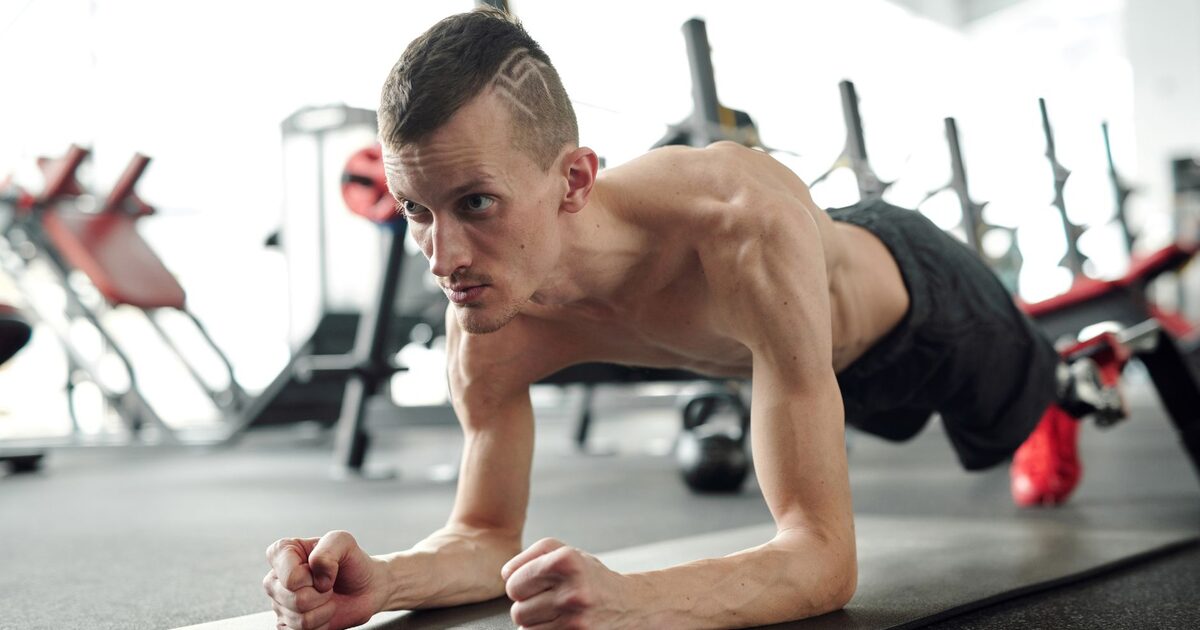
The plank looks like the easiest exercise in the gym: get on your elbows, hold still, breathe. That simplicity is exactly why most people do it badly. A sagging, three-minute plank trains your lower back to tolerate a slouch under fatigue. A 30-second plank you brace like you're about to take a punch trains the thing the exercise actually exists to build: a torso that refuses to move when load tries to move it.
What a plank is really training
Your core's main job during heavy lifts, sprints, and carries isn't to crunch your ribs toward your hips. It's anti-movement: resisting extension (the low-back arch) and rotation so force can travel cleanly between your hips and shoulders. The plank is the most direct way to practice anti-extension. Spine biomechanics researcher Stuart McGill built much of his "Big 3" around this idea, and his finding is the one most lifters ignore: bracing intensity matters far more than duration. A short hold at maximum tension beats a long hold you can only survive by letting your form fall apart.
That reframes the whole goal. You are not trying to outlast a clock. You are trying to produce as much full-body stiffness as you can and hold it cleanly, then stop before the quality drops.
The setup, joint by joint
Get into a forearm plank and run through this checklist from the ground up. Every cue below is doing a specific job, not adding polish.
- Elbows directly under shoulders. Stack them. If your elbows drift forward, your shoulders carry the load at a bad angle and you lose upper-body tension.
- Forearms pressing the floor. Push the floor away slightly to spread your shoulder blades and engage your serratus. No collapsing between the shoulders.
- Ribs down, slight posterior pelvic tilt. This is the cue that kills the sag. Tuck your tailbone a touch so your lower back flattens toward neutral instead of arching.
- Glutes and quads squeezed hard. Squeezing your glutes pulls your pelvis into that neutral position automatically and locks the hips. Tight quads pull your kneecaps up and keep the legs rigid.
- Neutral neck, eyes on the floor. Look at a spot about 20 cm in front of your hands. Don't crane up to watch yourself in the mirror.
- Keep breathing. Brace your abs as if expecting a punch, then take short breaths into that braced wall. Holding your breath inflates the time you can last but teaches you nothing useful.
Done right, a plank should feel like work everywhere: abs, glutes, quads, shoulders, even your grip on the floor. If you only feel it in your lower back, you've lost the brace.
Four faults that wreck the exercise
These are the ones I correct most often. Each has a single clean fix.
- Hips sagging. The classic. Your pelvis drops, your lower back arches, and the load dumps onto your spine. Fix: squeeze the glutes harder and re-tuck the tailbone. If you can't hold it, you're past your time limit, not weak. A muscular ache that fades is normal; sharp or lingering back pain is a signal to stop and, if it persists, get it checked.
- Hips piking up. The opposite cheat. Lifting your butt toward the ceiling turns the plank into a rest position because your hips take the load off your abs. Fix: drop the hips until your body is one straight line from ears to ankles.
- Breath-holding. You go rigid, stop breathing, and quietly turn it into a Valsalva endurance test. Fix: pick a breathing cadence (in for 2, out for 4) before you start and stick to it.
- Head craning. Looking forward or up extends your neck and drags the rest of the spine out of line. Fix: tuck your chin slightly and stare at the floor.
How long, how many
Forget the social-media plank challenges. For building stability, two formats work and neither involves a stopwatch ticking past a minute:
- Max-tension reps (McGill style): 5 to 10 second holds at the absolute hardest brace you can produce, resting briefly between each. Try 5 reps, rest, repeat for 2 to 3 rounds. This trains the nervous system to fire hard and fast.
- Standard sets: 2 to 4 sets of 20 to 40 seconds, full tension throughout. When 40 seconds becomes easy with perfect form, don't add time. Progress to a harder variation instead.
The progression rule is the part people get backwards: once you can hold a clean 40 to 45 seconds, adding more seconds gives diminishing returns. Add difficulty, not duration. If you want to log these and watch the numbers climb without guessing, tracking your hold times in the app makes the progression decisions for you.
Variations worth your time
Each of these changes what the plank demands, either lengthening the lever, adding an anti-rotation challenge, or loading it. Browse the full exercise library for video demos of each.
| Variation | What it adds | Suggested hold |
|---|---|---|
| High plank (hands) | More shoulder and wrist demand; easier on some lower backs | 30-45 s |
| Side plank | Trains the lateral core (obliques, quadratus lumborum) | 20-30 s per side |
| RKC plank | Pulls elbows toward toes for a brutal full-body brace | 10-20 s |
| Long-lever plank | Elbows forward of shoulders multiplies the anti-extension load | 10-20 s |
| Shoulder taps | Anti-rotation: resist tipping as you lift one hand | 30-40 s |
| Body saw | Rock forward and back on forearms; brutal on the abs | 8-12 reps |
| Weighted plank | Plate on the upper back for straightforward overload | 20-30 s |
A sensible path: own the standard forearm plank, add the side plank for lateral strength, then rotate in the RKC or long-lever version when you need more challenge in less time. The shoulder tap and body saw bridge you toward dynamic core work and movements like the ab rollout.
Where the plank fits in a program
The plank is accessory work, not a main lift. Its real payoff shows up under the bar: a braced torso protects your spine and transfers force on every hinge and pull. The same anti-extension brace you build here is exactly what keeps your lower back neutral during a Romanian or conventional deadlift, and the anti-rotation versions carry straight over to maintaining a rigid trunk during a barbell row. Treat planks as the drill that teaches the brace, then cash it in on the lifts that build the muscle.
Two or three short sessions a week is plenty: a couple of focused sets at the end of a workout, progressed by difficulty rather than duration. Core strength responds to the same things every other muscle does, which includes feeding it well. Enough protein and a recovery-friendly diet do more for a visible, capable midsection than any plank challenge, and a few high-protein recipes in rotation will get you further than an extra minute on the clock.
Key takeaways
- Brace like you're about to take a punch: tension intensity matters more than how long you hold.
- Ribs down with a slight posterior pelvic tilt plus squeezed glutes kills the lower-back sag.
- Skip the clock chase. Use 5-10s max-tension reps or 2-4 sets of 20-40s with full tension.
- Once you can hold a clean 40-45 seconds, add difficulty, not more seconds.
- Fix the four big faults: hips sagging, hips piking, breath-holding, and head craning.
Frequently asked questions
How long should I hold a plank?
For building stability, 20 to 40 seconds per set with full tension is plenty, or even 5 to 10 second max-effort holds. Once you can hold a clean 40 to 45 seconds, stop adding time and switch to a harder variation instead.
Why does my lower back hurt during planks?
Almost always because your hips are sagging and your spine is arching, which dumps the load onto your lower back. Tuck your tailbone slightly, pull your ribs down, and squeeze your glutes hard to bring your spine back to neutral, and shorten the hold if your form slips. A muscular ache that eases off is normal, but sharp, radiating, or lingering pain means stop and see a physio or doctor before continuing.
Is a forearm or high plank better?
Neither is universally better; they stress things differently. The forearm plank is the standard anti-extension drill, while the high plank adds shoulder and wrist demand and can feel easier on some lower backs. Use whichever lets you keep a perfectly straight line with full tension.